Core services

Eight services, one component data pipeline.

Most libraries fail in the gaps: a symbol that doesn't match its footprint, a part number that no longer exists, a `DNP` variant nobody documented. Our services are split so you can buy exactly the gap you have — or hand over the whole pipeline.

01
Schematic data

Schematic symbol creation

Symbols built from the current datasheet, not copied from a public library. Pin numbers, names, electrical types and alternate functions are mapped to the exact package variant, so ERC catches real problems instead of library noise.

Multi-part devices are split by function, with power pins handled explicitly and a consistent unit lettering scheme.

  • Multi-part and multi-unit symbols
  • IEC 60617 / ANSI style options
  • Power, passive and no-connect pin types
  • Alternate function pin names
02
Land patterns

PCB footprint & land pattern design

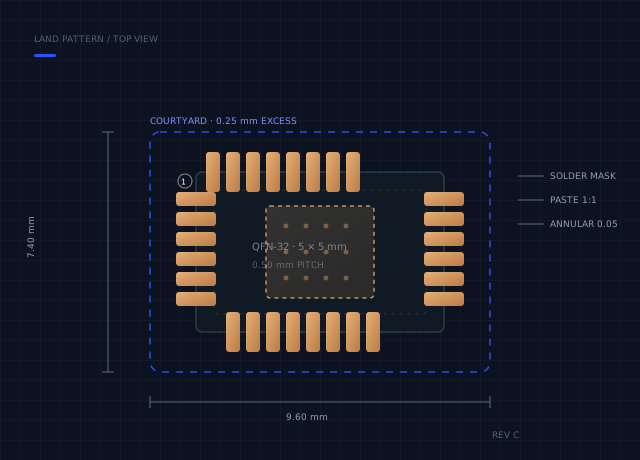
IPC-7351B land patterns for QFN, BGA, LGA, QFP, SON, chip components, connectors and modules — with pad geometry, mask opening, paste aperture and courtyard derived from the package drawing and your chosen density level.

Thermal pads include a verified via array and paste windows. Every part ships with a matched 3D STEP body.

  • Density A / B / C per IPC-7351B
  • Courtyard, assembly and silkscreen layers
  • Thermal pad and via array design
  • STEP AP214 3D models
03
Library operations

ECAD library management

A single governed library with part numbers, revision history and a review trail. We define folder structure, naming rules and approval states, then keep the vault clean as new parts arrive.

Works with Altium 365, Cadence library manager, Siemens library tools, KiCad libraries and shared network vaults.

  • Naming and parameter conventions
  • Revision control and change logs
  • Duplicate detection and cleanup
  • Review workflow and release gates
04
Part data

Component data enrichment

Turn a bare part number into a record your team can design, buy and audit from: manufacturer, datasheet revision, package, tolerances, lifecycle state, compliance and approved alternates.

Fields are mapped to your ERP/PLM keys so the library and the BOM speak the same language.

  • MPN, manufacturer and description cleanup
  • Parametric attributes and tolerances
  • RoHS / REACH compliance status
  • Lifecycle state and PCN/EOL flags
05
Procurement data

BOM validation & AVL support

We scrub the BOM before it reaches purchasing: missing MPNs, package mismatches, non-approved alternates, inconsistent quantities and parts that are NRND or already end-of-life.

Alternates are checked on function and footprint, not just value — a “close enough” capacitor can change your loop stability.

  • BOM scrub and exception report
  • AVL / AML cross-check
  • Footprint-to-BOM consistency check
  • Obsolescence and supply-risk flags
06
Platform work

Library migration & consolidation

Moving from Allegro to Altium, PADS to Xpedition, or a folder of legacy files to a managed vault? We translate, de-duplicate and re-verify rather than trusting the converter output.

Each migrated part gets a visual and geometric check against the source before it is released.

  • Cross-platform library translation
  • Legacy part audit and deduplication
  • Geometry verification after conversion
  • Mapping and traceability report
07
Board design

PCB layout & design support

Schematic capture, placement and routing support for teams that need an extra pair of hands — from a two-layer control board to a high-speed design with controlled impedance, length matching and a documented stackup.

We work to your templates and layer conventions, or supply a review-ready draft for your own engineer to sign off.

  • Schematic capture and netlist cleanup
  • Placement and routing support
  • Stackup and impedance planning
  • Gerber, ODB++ and IPC-2581 output
08
Release checks

DFM review & obsolescence

A manufacturability pass before you release: annular ring, mask webs, silkscreen clearance, solderability, panelization and assembly-side checks — reviewed against your fab and assembly house capability, not a generic rule set.

We also monitor lifecycle status so EOL and PCN notices turn into planned revisions rather than emergency buys.

  • DFM / DFA review report
  • Panelization and fiducial check
  • Assembly drawing and variant review
  • EOL monitoring and last-time-buy alerts
Inside the work

The footprint is the part that touches the board.

A symbol can be fixed in minutes. A footprint error means a re-spin. This is why our builds start with the package drawing and end with a print-to-scale check, not with a downloaded file.

DensityPadCourtyardBest for
A · MostLargest0.50 mmHand soldering, rework
B · NominalBalanced0.25 mmStandard SMT
C · LeastSmallest0.10 mmHigh density, automated

Courtyard excess values vary for small chip components — always confirm against IPC-7351B.

  • Source checked, revision noted

    We record which datasheet revision and package variant the part was built from.

  • Geometry checked twice

    Builder review plus an independent QC pass on pads, mask, paste and courtyard.

  • Printable proof

    A 1:1 PDF comparison against the manufacturer drawing catches scale and orientation mistakes.

Land pattern drawing with pads, courtyard, thermal pad and dimension callouts
Standards

The documents our work is measured against.

We build to the standard your assembly house audits against. If a project needs a company-specific rule set, that rule set becomes part of the build checklist.

IPC-7351B Land pattern geometries and the A/B/C density levels used for every footprint we build.
IPC-2221 / 2222 Generic and rigid board design requirements — clearances, vias, conductors, assembly.
IPC-A-610 Acceptability of electronic assemblies: what a good joint, fillet and placement actually look like.
IPC-6012 Qualification and performance of rigid PCBs, including annular ring and plating requirements.
IPC-2581 Digital product model exchange for handing a complete, unambiguous design to fabrication.
J-STD-001 Soldering requirements for the assembly process your footprints and paste apertures feed into.
FAQ

Questions we get before the first part.

No remote access is needed. You send the template, library conventions and the part list; we build in the matching tool and deliver native library files, a change log and a review report. If you use a managed vault such as Altium 365, we can work to its folder and parameter structure.

Density B (nominal) unless you tell us otherwise. If the board is hand-assembled or will see rework, A is safer; if you are pushing density on a compact design, C saves space at the cost of rework access. The choice is recorded per part.

We cross-check the pin table, package drawing, top-view marking and, where available, the manufacturer's recommended land pattern. Pin 1 is marked in copper, silkscreen and the 3D body. A second engineer repeats the check before release, and the source revision is logged in the part record.

Yes. We start with an audit: geometry against the datasheet, naming consistency, duplicate parts, missing 3D models and lifecycle status. You get a prioritised defect list with an estimate, then we repair what matters and version the changes.

The CAD tool and version, the part list or datasheets, your density preference, any library template or naming rules, and your deadline. For layout work, add the schematic, mechanical constraints and board outline. A 20-part quote normally comes back the same day.

Yes — STEP AP214 bodies matched to the footprint origin and orientation, with the body checked against the package drawing. This keeps enclosure clearance checks and connector height conflicts meaningful in the mechanical assembly.

Tell us the gap. We'll scope the fix.

Single part, a 200-part BOM, or a library that needs a full audit — send what you have and we'll reply with a plan.